Sunday, 19 February 2012

Polaroid 340M - First Photos

My finished prototype Polaroid 340M. The shutter speed selection dial is still a little clunky, but all the functionality is there.


I have run a test film through the camera, and I am very pleased with the results.


- Posted using BlogPress from my iPad

Saturday, 11 February 2012

Polaroid 340M - Automatic to Manual Conversion

I have wanted a folding Polaroid Land Camera with a manual shutter since I bought by first Land Camera and found out just how simple the metering system was, and how easy it was to unintentionally fool it.

Polaroid themselves did make several manual shutter models, but they are rare and expensive. So, I started to research how easy it would be to convert the automatic electronics that control the shutter to manual. That's when I found out that someone had already done this and put their results on their website. http://www.chemie.unibas.ch/~holder/shutterpic/index.html

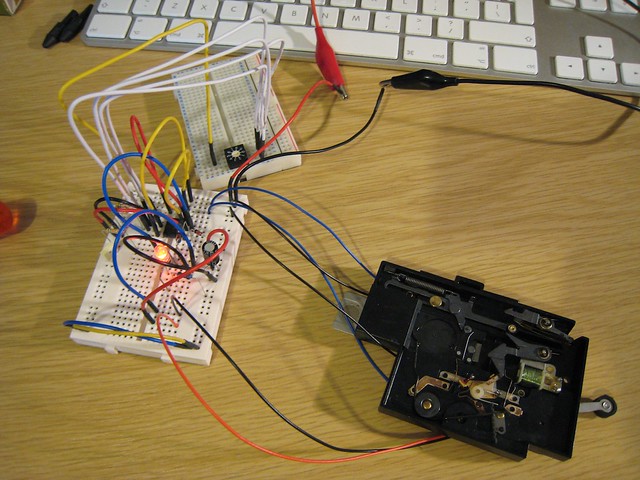
The information was pretty much all there, I just needed to fill in a few gaps and source the parts. I had recently converted my Polaroid 320 to a Polga (Polaroid / Holga hybrid) and one of the parts removed from the Polaroid for the conversion was the shutter. So I started to mock up the replacement electronics on breadboard and connected it to the shutter.

I had changed a few components that were specifically mentioned on the website and also made best guess estimates at the values of a couple that weren't. To my surprise, everything worked first time. :)

Testbed

After some further testing, I noticed that there was a problem. It looks like the shutter I was using behaved differently than the one that the original designer had used. Specifically one of the switches that I was connecting to was fluttering as you prime the shutter and this was confusing the PIC. I also found that it was possible to accidentally open the shutter if you do not fully cock the shutter correctly, thereby exposing the film. (This happens towards the end of the video below).


These were minor problem though, as I wasn't going to be using this shutter on the final camera - a Polaroid 350. However, it did mean that I needed to do further testing on a shutter more similar to the one found on my target camera. This was when I remembered that I had a broken Polaroid 340. From what I could tell the 340 was the plastic version of the 350. The problem with the 340 was that the electronics didn't work. This was perfect as I would be removing them anyway.

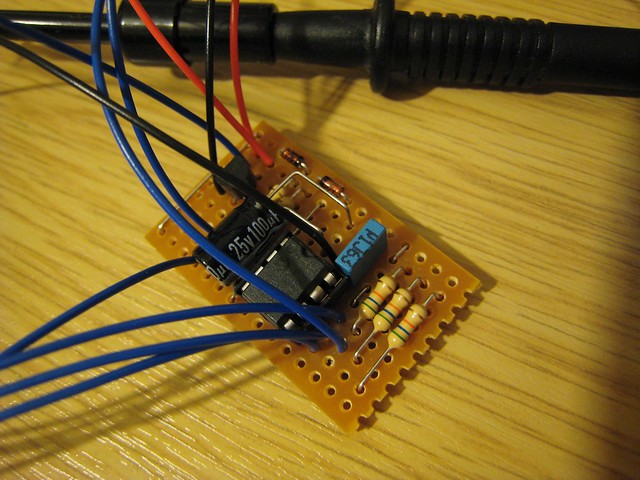
So I could keep my (working) reference design, I decided to keep the breadboard version intact and build another version of the circuit using veroboard (stripboard). Most of the components were cheap, I had bought extra.

Veroboard Version

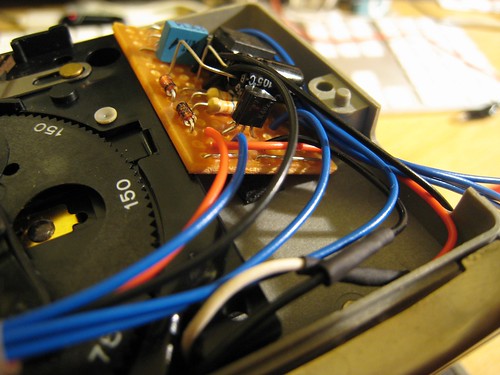
I converted the camera to 2x AAA batteries, and then installed my new shutter electronics. It would seem that somewhere alone the line my measurements for the maximum size of the veroboard had changed. My board was a little bit too big. Luckily, it would still fit if I put it in the space diagonally. Noted for next time...

Measure Twice...

I had a weird problem to begin with - the circuit that was drawing a maximum of 40mA on the bench, was drawing over an amp when it was installed in the camera. Other than that it was still working as expected. I disconnected the power quickly and took the camera apart again. I couldn't find any sign of a short, and the enclosure it was mounted in was plastic (so non conductive). I wrapped the circuit in a couple of layers of packing tape and put it all back together. Everything worked as expected then.

So here's the video of the shutter working with the new electronics. I go through each shutter speed from slowest to fastest and then bulb. Enjoy.


For more photos and video of the build process and testing, look here.

Tuesday, 24 January 2012

Instructables.com

I've recently written up a couple of instructables. One about converting a 1970's Polaroid Land Camera to use modern film and batteries (Fuji and AAA) and another about my experiences fixing a broken Bronica SQ-A Film Back.


Polaroid Land Camera Fujifilm and Battery Mod

Fixing a Broken Film Transport on a Bronica SQ-A Film Back


Tuesday, 27 December 2011

Reconditioning my Polaroid 350 Land Camera

Just finished cleaning the lens and discovered why the camera was vignetting under some conditions. The lever that cocks the shutter was badly bent, as it looks like the camera was dropped at some point in the last 50 years. The lever has a limited amount of travel and when the shutter is released, it flies back to the home position. As the level was bent it was reaching the end of it's travel before it was in the home position, meaning that the shutter was never fully open. I've now bent it into the correct shape and the shutter works correctly now.

This web site was useful to show how to open up the lens board and get at the shutter: http://www.instantoptions.com/conversions/350/350.5.php

Sunday, 25 September 2011

Silverfast and Lion - Part 2

I finally managed to get the software to work after LSI said that the problem must be my fault. I had to manually trawl through my disk removing anything that SilverFast had installed, then reinstall SilverFast 8. So it looks like their upgrade process hadn't worked.

On a side note, I had an horrific customer experience over this, and I said as much to the customer support representative - who just ignored my complaint. At no point did they offer a refund or even apologise.

I will be actively looking for an alternative scanning solution in the future, this is the last LSI product I pay for.

Wednesday, 24 August 2011

Silverfast and Lion


Sorry for the following rant...

Since I upgraded to Lion (OSX 10.7) my scanner hasn't worked. When I started a trouble ticket with the makers of Silverfast I was informed that it was incompatible with Lion, but that a new version of Silverfast (version 8) was immanent and that does work with Lion. OK, annoying but something I could live with as the new version was only about a month away. (I usually shoot 2 to 3 rolls of film a week and develop them myself, scan the negs and put them up on Flickr - so a month was a big deal, but not the end of the Earth).

Whilst I was killing time waiting for the new version, I though I would see if I could find a little more about the problem. This is where I found a little architectural quirk that worked in the companies favour. They have a launcher application that you run and then choose which one of their suite of products you want to use, and it is then executed. As I only have the scanner application this is redundant in my case as I always click on the scanner icon. You'll see why this is relevant in a moment.

Apple changed the CPU in their hardware about 5 or 6 years ago from the PowerPC CPU to Intel Core based CPUs. Naturally this changed the instruction set and therefore code that was written for the PowerPC would need to be rewritten. That's a lot of applications that would need to be changed almost overnight, so Apple created something called Rosetta that allows your to execute PowerPC instructions on an Intel CPU. They then created an application compatibility program called 'Universal' (which has a special logo) that means an application has been written for the Intel Macs.

As I said above, this was a number of years ago. Apple kept support for Rosetta in several releases of their operating system whilst developers transitioned their applications from the old architecture to the new. In the latest version of OSX (Lion) they finally dropped support for Rosetta after several years. This was well publicised and I checked my main applications to make sure they were Universal before I upgraded to Lion.

Can you guess where I'm going with this? The launcher application was a Universal application so had Apple's Universal logo on it. The scanner application that it launched was a PowerPC application, so could not run on Lion. This seemed a little sneaky to me as I saw the Universal logo on the launcher and assumed the whole application was Universal, not just a small part. This did not make me happy. :(

The next bit annoyed me even more. Silverfast came bundled with my scanner. Because I bought my scanner more than 2 months before the release of Silverfast 8, I wasn't eligible for the free upgrade to version 8. But I could upgrade at a discounted rate. Why only 2 months? That seems unfair to me. :(

So, I grudgingly paid the upgrade cost. It wasn't that much (about €30) and I was itching to get back to scanning again. I installed the new version with baited breath. It doesn't work either! >:( So I now have another trouble ticket open with them to get this sorted out. They sent me an automated email saying they were experiencing an unusually high volume of technical support requests and that they will take longer than usual to respond. I get the feeling I'm not the only one having problems.

So, in short, I am not a happy customer.

Sunday, 21 August 2011

DIY Colour Development

I wasn't sure if the chemicals had expired since I mixed them up, so I thought I would give them a go.

PB_BC1 00009 Basingrad

They seem to be OK, but I need a thermometer that goes over 28C...